 SurveyorSim
for sim players · the deep-machine page
You've flown the 747. You've driven the combine. Now run the instrument.
Land surveying is the original precision game: optics, geometry, and a number at the end that tells you exactly how good you were. SurveyorSim models the whole machine — a total station you level with real footscrews, a telescope with a real reticle, and an error budget that punishes lazy technique the way a crosswind punishes a lazy flare.
no install · gamepad supported · your misclosure is your score
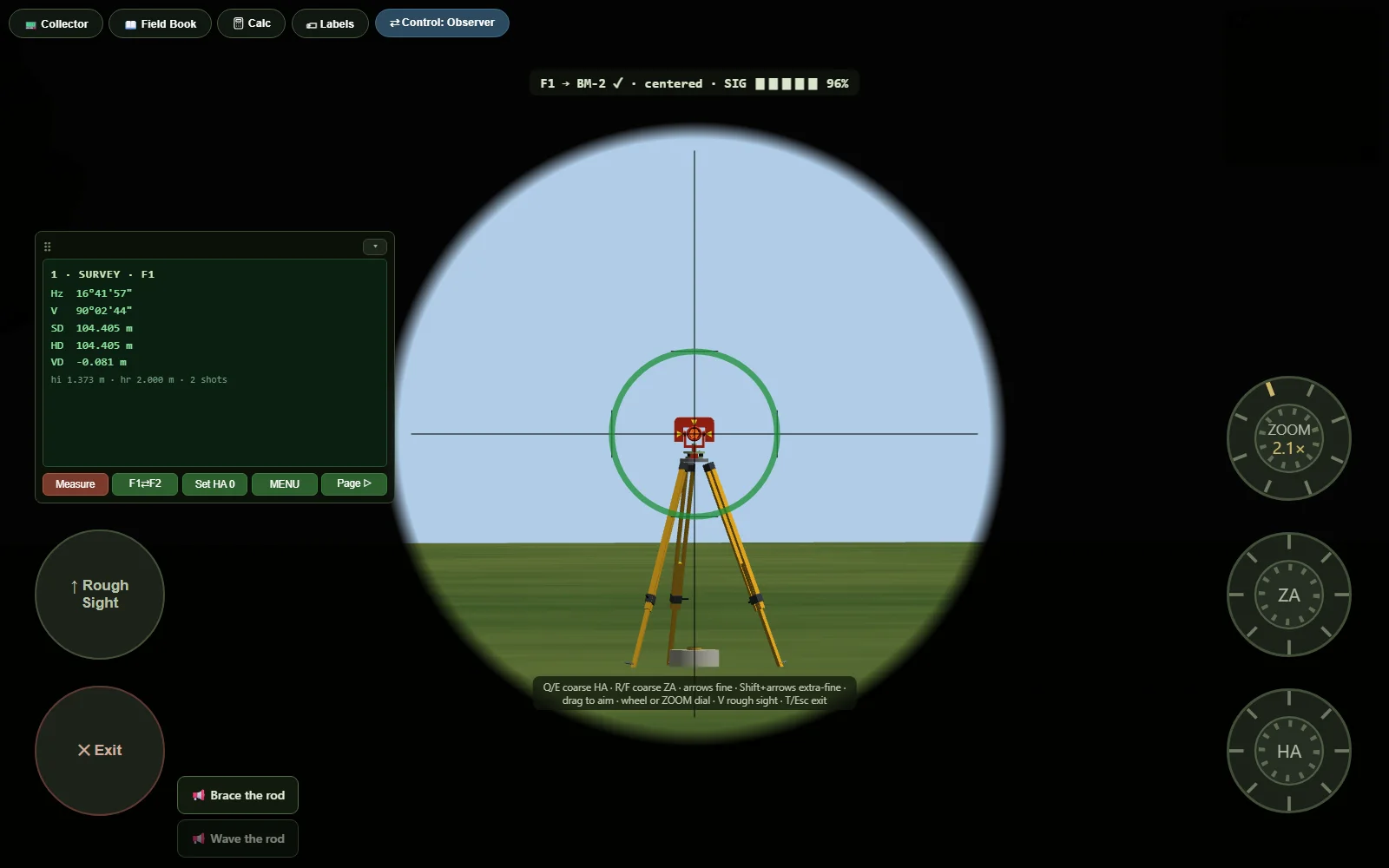
The machine is the game
systems, not skinsSim games live or die on whether the machine underneath is real. This one is: the angles come off a modeled circle with a modeled collimation error; distances come off an EDM with a prism constant you'd better have set; the level's rod is drawn to exact graduation geometry, and you read it — with your eyes — to a hundredth of a foot.
- Setup is a skill. Legs, bubble, optical plummet, footscrews — a real centering ritual you get fast at, then take pride in.
- Two faces, one truth. Flip the scope, shoot both faces, and watch instrument error cancel out of your mean. Deeply satisfying. Completely real.
- Weather is mechanics, not mood: temperature and pressure change your distances (parts per million matter here), wind and fatigue move your rod.
- The paperwork is gameplay. You keep an actual field book — ruled pages, a graph-paper sketch side, and in class assignments it is kept in ink, no eraser.
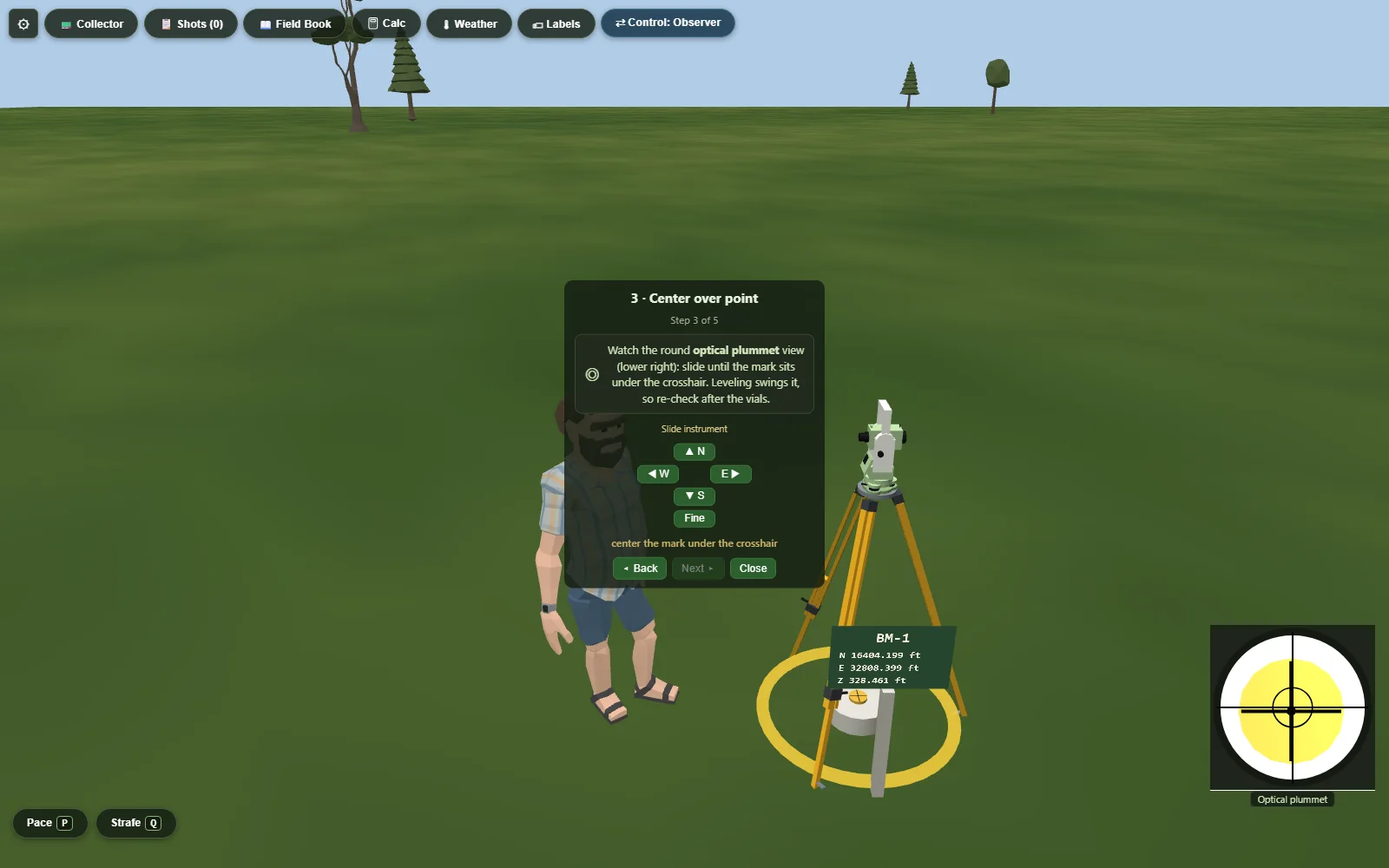
Things to do out there
Run a one-person crew
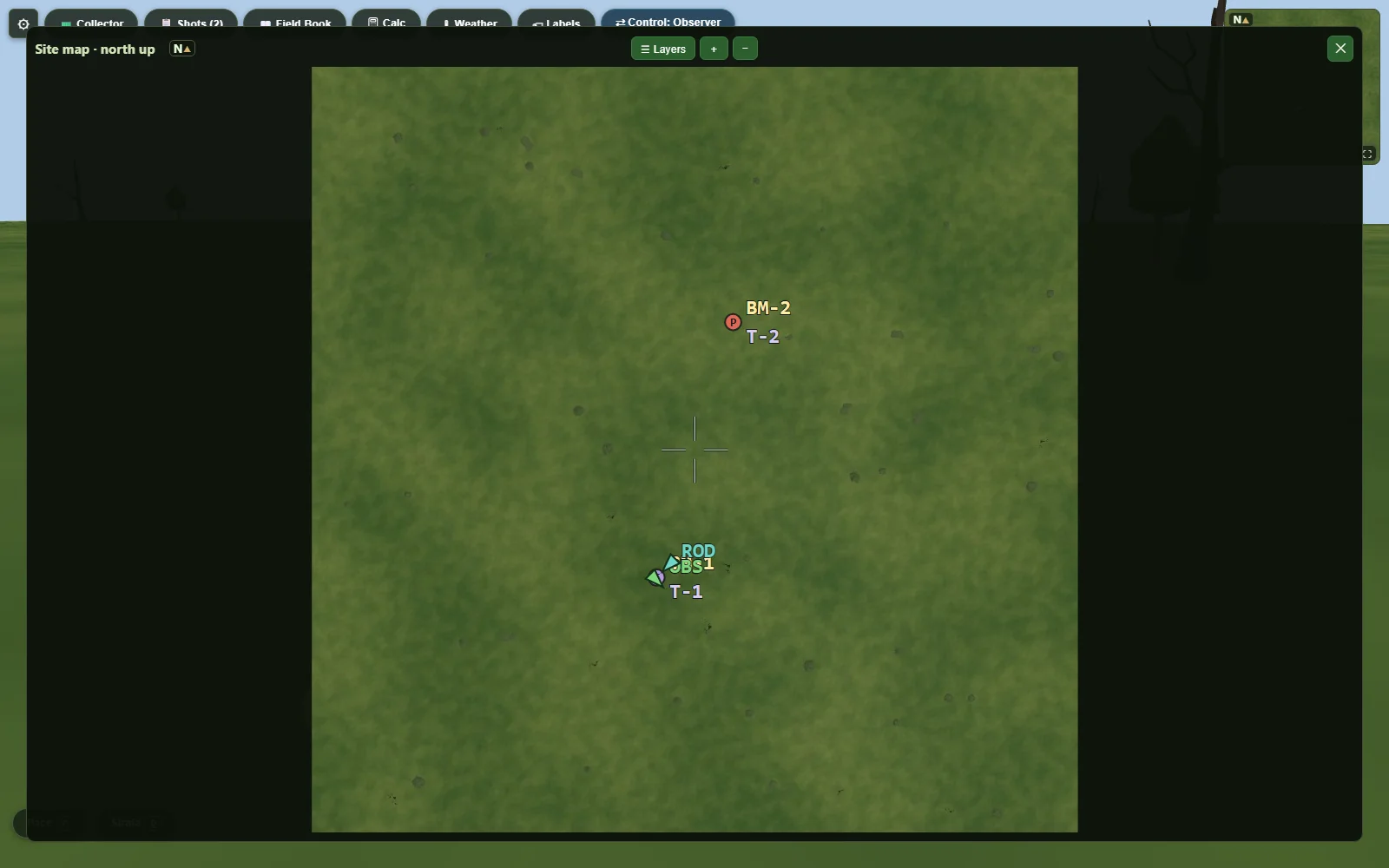
Switch between observer and rodman with a keypress — set the instrument, walk the rod out, sight yourself, book it. Level loops, closed traverses, taped baselines: the closure at the end is your score, in hundredths.
Monument recovery
Somewhere under that field is an iron rod a crew set decades ago. Take the magnetic locator, sweep for the signal spike, dig where the needle says — metal-detector treasure hunting where the treasure is a property corner.
Crew up
Host a room, hand out roles: one of you on the instrument, one on the rod, one running the data collector. Chain a line as a pair — each holding an end of a real 100-foot tape. In-session crew text chat included — bring Discord for voice.
Weather you have to work around
Fog that eats your sight distance, rain on the objective, wind that pushes the rod, heat that changes what the EDM reads. It isn't a filter over the camera — the thermometer and barometer are instruments you read, and the numbers you enter on the total station are the ones that correct your distances.
Honest difficulty
The error model scales from Zero — every instrument error switched off, which is the tutorial the geometry deserves — up through realistic noise where only clean procedure closes a loop. Even at Zero the earth is still round: curvature and refraction are geometry rather than instrument error, so a long sight reads low at every setting and correcting it is your job. No rubber-banding, no RNG mercy. The instrument doesn't care. That's the charm.
For the spec-sheet readers
we know who you are. we are you.Close a loop tonight
Free, in the browser, five minutes to your first shot. The misclosure will haunt you pleasantly.